Smallholder Support
Building Fairer Futures
for Smallholder Farmers
Smallholder farmers are the backbone of global agricultural production. Worldwide, around 510 million farms operate on less than 2 hectares of land. Their production sustains food security for billions and includes commodities such as cocoa, coffee, palm oil and natural rubber.
Although essential, smallholders face structural disadvantages: They often lack formal land rights and have limited access to knowledge, training, finance, data and digital tools. Women farmers and indigenous communities are especially affected by these constraints. Smallholder plots are often too small to earn an adequate income, and weak bargaining power, compounded by a reliance on other actors’ processing and logistics infrastructure, means much of their produce is sold to local intermediaries at low prices.

Copyright: Nyani Quarmyne / GIZ
At the same time, regulations and internal policies set high standards for quantity, quality and sustainability – standards smallholders must meet to access or remain in international value chains that offer better prices.
Supporting smallholders therefore serves three goals at once:


1. Reducing poverty and ensuring a living income

2. Strengthening global food security
3. Building fairer, more resilient agricultural value chains
Key Facts
smallholders worldwide produce cocoa, coffee, natural rubber and palm oil
of global coffee is produced by 12.5 million
small farming households
received by women in the agricultural sector for every dollar men make
Our approaches and goals
Meeting EUDR Requirements
The implementation of the EU Deforestation Regulation (EUDR) creates new requirements for value chain actors and can present particular challenges in smallholder-dominated supply chains. These include the collection and management of geolocation and production data, traceability, documentation and access to reliable information on the legal framework of the EUDR.
Smallholders may have limited capacity, connectivity, access to digital tools or formal documentation to meet these requirements independently. Collective approaches, capacity development and appropriate digital public infrastructure can help reduce these barriers while ensuring that farmers understand and retain control over their data. The goal is to reduce the risk of smallholder farmers losing access to European markets.
Strengthening farmer organisations and cooperative approaches
Cooperatives, producer organisations and other group-based models can help smallholders overcome some of the disadvantages associated with fragmented production. They can facilitate joint training, data collection and traceability, improve access to inputs and finance, strengthen bargaining power and enable producers to engage more effectively with buyers and public institutions, which can lower input costs and improve sales prices.
Group-based approaches can also reduce the cost and complexity of meeting sustainability and due diligence requirements. At the same time, such models need to ensure that smaller, less-connected and marginalised producers are not excluded from participation or decision-making.
Improving Agricultural Practices and Climate Resilience
Smallholder farmers are trained in good agricultural practices to maintain and improve production capacity. This includes awareness of deforestation-free production, reducing the use of chemical inputs, managing pests and diseases, protecting soils and setting up more diverse agroforestry and intercropping systems. Rehabilitation of old tree plantations and access to certified planting material support long-term productivity, while climate adaptation plays a central role — for example in the coffee sector in Northwest Vietnam.
Promoting digital tools, geolocation mapping and data ownership
Farmers receive guidance on geolocation mapping and training on the management of their data to use digital traceability tools to document their production. Mechanisms are being implemented to empower smallholders by ensuring they retain ownership and
Identifying and Mitigating Value Chain Risks
Smallholder groups jointly identify risks in their production area — including risks linked to deforestation, legality compliance and to gender inequality and socio-economic disparities — and develop strategies to address them.
Supporting Gender Equity and Social Inclusion (GESI)
Smallholder groups jointly identify risks in their production area — including risks linked to deforestation, legality compliance and to gender inequality and socio-economic disparities — and develop strategies to address them.
Access to finance and investment
Access to appropriate finance is a key enabling condition for smallholder farmers to invest in sustainable production, improve productivity and adapt to changing market requirements. Yet smallholders often face limited access to formal financial services and investment capital as financial institutions tend to perceive smallholder farming as risky and tailored support for business planning is rarely available.
Support approaches include savings and group-based finance, improved access to blended public and private financing, agreements with buyers, inclusive business models and innovative mechanisms such as payments for ecosystem services. Connecting smallholder support with sustainable finance can help turn sustainability requirements into opportunities for long-term investment rather than additional cost.
Towards adequate incomes and fairer value distribution
Meeting sustainability requirements is difficult to sustain where smallholder production does not generate an adequate livelihood. Low farm-gate prices, limited bargaining power, rising production costs and climate-related risks can leave farmers with insufficient income to meet their household needs, invest in their farms or absorb additional compliance costs.
Approaches to smallholder support therefore need to consider income and value distribution across the value chain. This includes exploring pathways towards living incomes and, where relevant, living wages for workers, alongside productivity improvements, market access, stronger producer organisations and more equitable business relationships.
Land rights, labour conditions and social protection
Secure land and land-use rights can provide an important foundation for long-term investment in sustainable agricultural practices. In some contexts, smallholders also face challenges related to informal or seasonal labour arrangements, limited awareness of and respect for labour rights and restricted access to social protection.
Addressing these structural issues can strengthen both livelihoods and the resilience of deforestation-free value chains. These remain a significant challenge for smallholders, particularly considering seasonal work arrangements, limited awareness of labour rights, and the lack of documentation and flexible formalization mechanisms, which limit access to social protection and increase vulnerability.
Partnerships between Public, Private Sector and NGOs
Smallholder support activities are implemented jointly with private sector companies and non-governmental organisations, combining resources and expertise across the value chain. These activities include trainings for smallholder farmers, geolocation mapping, digital and financial literacy or the development of community forest management plans.
Learning from practice
Smallholder support is highly context-specific. Experiences across countries and commodities provide important lessons on what works — and where approaches need to be adapted.
The TEI brings together experiences from projects working with smallholders across several value chains and collects on these lessons learned and best practices for global learning purposes. Together we identify which success stories are scalable and adaptable to other contexts and regions. This can help inform more inclusive approaches to smallholder support — from the design of training and digital tools to farmer organisation, finance and engagement with private sector partners.
Case studies and smallholder perspectives
Multistakeholder dialogue processes
Gender Equity and Social Inclusion - GESI Sprint experiences
E-learning courses
Methodologies
Examples
Lorem Ipsum
Lorem Ipsum
Projects and Activities
Explore projects working with smallholder farmers across commodities and regions, as well as tools, case studies, publications and other resources that provide practical insights into building more inclusive and deforestation-free value chains.
Publications
These are our latest Smallholders publications. To narrow down your search, use the Library’s search and filtering functions by selecting the “smallholders” tag and adding a specific keyword.
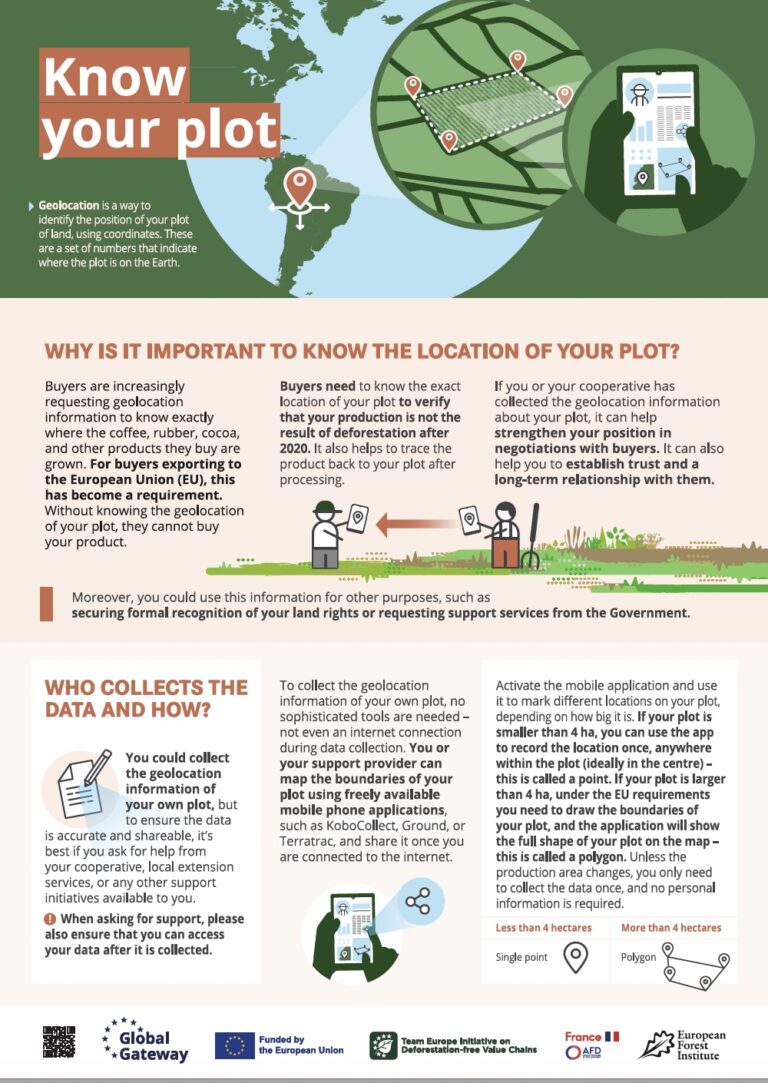
To ensure that smallholder farmers are included in global supply chains for agricultural products like coffee, cocoa, rubber, palm oil and others, it is important to have the precise geolocation…

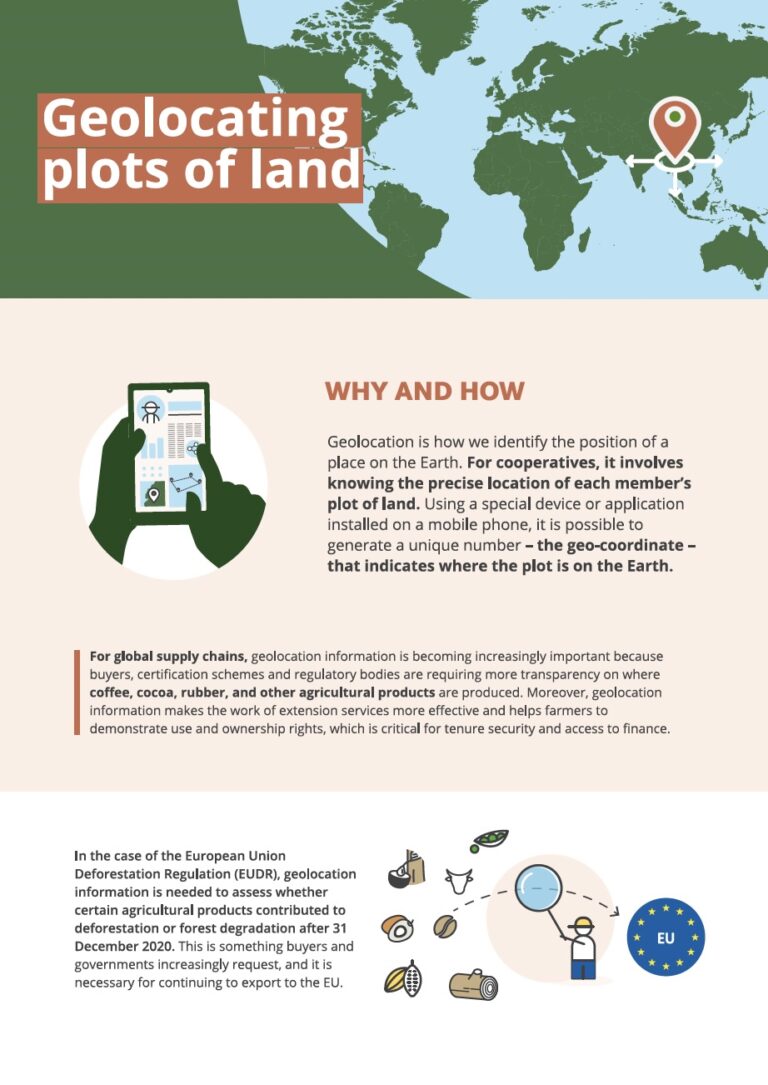
Knowing the precise location of the plots of land where an agricultural commodity was produced is becoming increasingly important for global supply chains amid a growing focus on traceability. Regulations,…

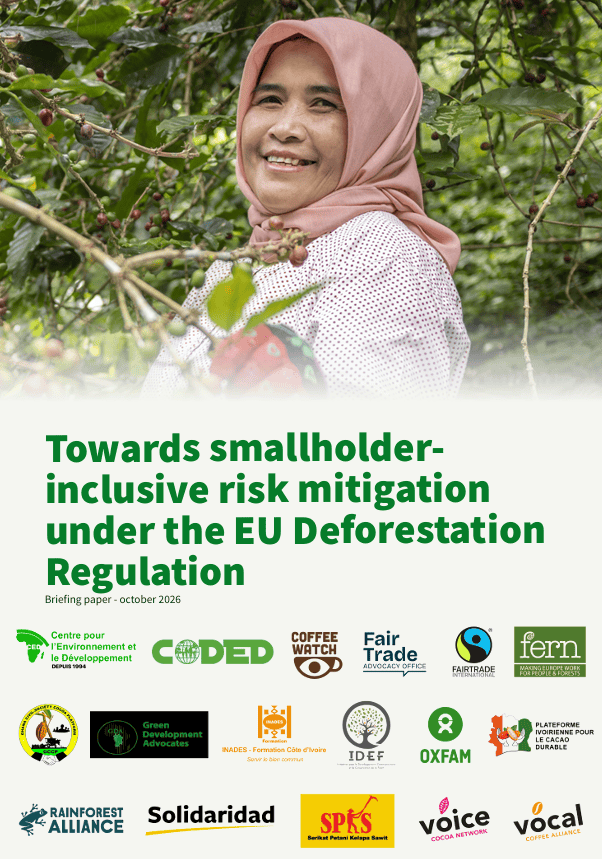
This briefing, endorsed by EU and non-EU organisations including smallholder representatives, offers recommendations for companies, Competent Authorities and the European Commission on implementing risk mitigation under Article 11 of the…
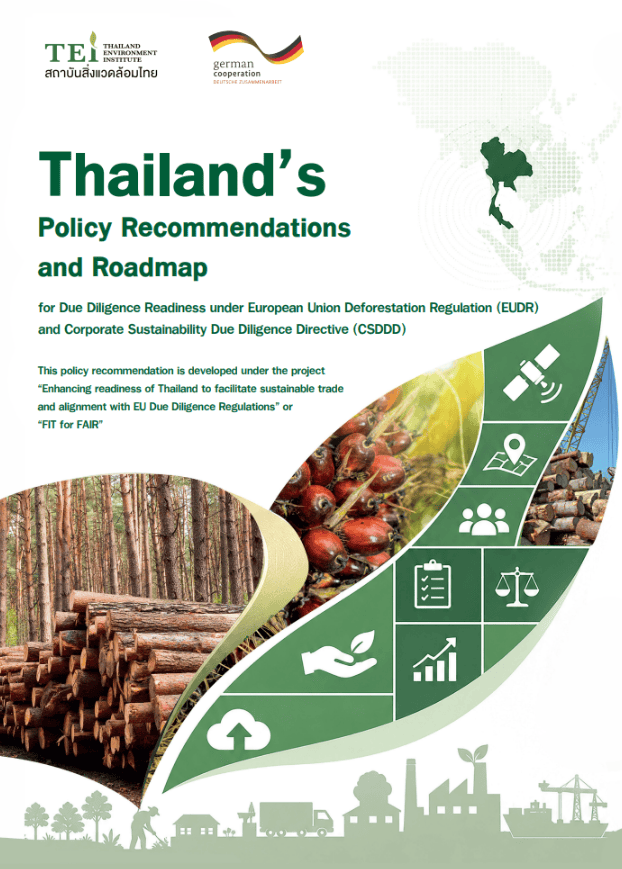
Developed as part of the FIT for FAIR project, the report provides policy recommendations and a national roadmap to support the preparation of Thailand’s supply chains for evolving due diligence…

Increasing due diligence requirements are shaping how producing countries prepare agricultural value chains for access to European markets. This report synthesises cross-country experiences and lessons from the FIT for FAIR…

This study provides an empirical assessment of Ethiopian smallholder coffee farmers’ preparedness for the European Union Deforestation Regulation (EUDR), examining awareness, compliance capacity, and potential impacts, with particular attention to…


Independent smallholders produce a significant share of the world’s palm oil but remain underrepresented in the traceable, certified, and compliant supply chains increasingly shaping market access. The Global Palm Oil…


The market conditions that helped drive sustainable palm oil over the past two decades are changing. The Global Palm Oil Outlook 2025 finds that future demand growth is increasingly concentrated…
Partner organisations
Strengthening Interoperability Through Partnerships and Alignment
Building effective Digital Public Infrastructure requires collaboration across governments, international organizations, technology providers, civil society, and the private sector. Explore how our partners work together to develop shared standards, promote interoperability, and coordinate open-source digital solutions.