

This morning I asked my colleague Jesus Diaz, from Peru, whether farmers were seeing any financial benefits from organizing compliance with the EU Deforestation Regulation (EUDR). For example, are buyers offering to pay more for compliant material?
Jesus looked surprised by that question. Farmers are working to meet the regulation’s requirements, including organising legality documents and polygon data. But these are organized and pre-financed by their cooperative, and farmers are expected to pay the money back.
Now, surely supporting farmers was not the primary intention of the EUDR. Its intention is to ensure the production of goods intended for the European market are not linked to deforestation. A legitimate, worthwhile pursuit. We cannot fault the intention of the EUDR, yet its implementation tells another story: a story of unintended consequences. In this story we see the costs of compliance ending up on the ledgers of under-resourced smallholder farmers, and often we see them unable to meet these demands and as a result we see them ‘passively excluded’ from the EU’s market.
This is happening in the context of increasing geopolitical tension putting strain on trade and livelihoods, and it is happening as climate change begins to take its toll on agricultural landscapes. In such a hard time I know that most of us would want to see the opposite: Namely to see vulnerable smallholders supported in their journey towards more resilience.
EUDR: what does compliance mean?
Which brings me back to the EUDR. If we want to support farmers in this period, while achieving the objectives of the EUDR, we need to rally behind implementation strategies that do not exclude the farmers who cultivate the coffee, cocoa, rubber and oil palms that feed us and power the global economy. Instead we need an implementation of EUDR that supports real change, resilience and livelihoods. And there is a way to get there: a way to achieve a win-win implementation. But it will take a change of strategy from both companies and the competent authorities charged with enforcing the EUDR.
Let me explain.
- The EU Deforestation Regulation (EUDR) will apply as of 30 December 2026 for large and medium operators, and six months later for micro and small operators.
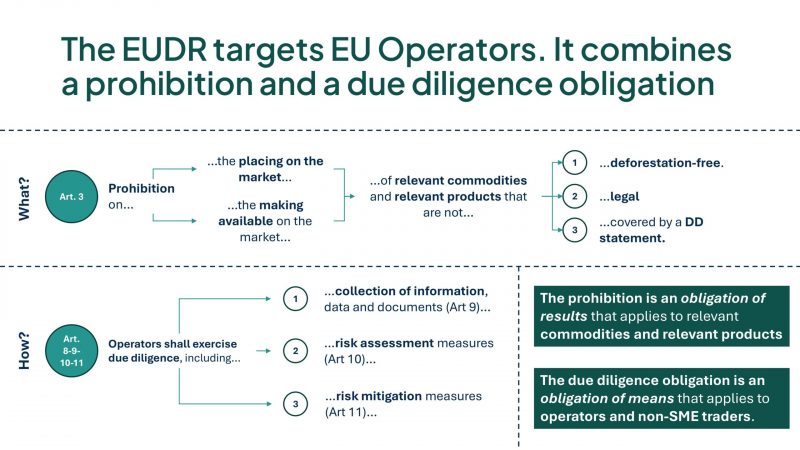
- According to article 3 operators importing products into the EU that are in scope of the EUDR need to ensure their products are deforestation free and legally produced (according to the laws of the sourcing countries) and declare this in a Due Diligence Statement.
- The articles 8, 9, 10 and 11 require operators to exercise due diligence prior to bringing products on the EU market. For products with a non-negligible risk to associated deforestation, operators are required to implement risk-mitigation measures. If the risk cannot be brought down to a “negligible” level via mitigation, trading the product is prohibited.
The EUDR thus combines a prohibition (article 3) with a due diligence obligation regarding the products potentially associated with deforestation (articles 8-11). I believe that we need to explore opportunities for competent authorities and companies to implement risk mitigation approaches related to the concerned shipments, as opposed to excluding smallholders involved. This would mean that, when the due diligence system is properly applied and implemented, and appropriate mitigation measures are tied to the imported product, the Risk-based due diligence (Arts. 8–11) is seen as the process to achieve compliance (Art. 3).
Excluding smallholders does not reduce deforestation
What this means for each commodity will be slightly different, depending on the European market share and volume produced by smallholders, but let’s take the example of palm oil. When it comes to palm oil, corporates have a choice to source exclusively from bigger estates and players, meaning that they can entirely avoid smallholder farmers as a means of complying with the EUDR. This lets them avoid the additional work of smallholder inclusion. In the case that these specific smallholders were linked with deforestation – which is most often NOT the case – then supporting these smallholders is an inherently better approach to achieving the underlying goal of the EUDR of avoiding deforestation. If we work with these deforestation linked farmers we can help them move away from this practice. Once the products from deforestated lands are on the market, it is too late to prevent the deforestation, meaning that the EUDR, in such cases, has failed in its ultimate goal.
Of course it is not one-size fits all. In the cocoa and coffee sectors sourcing from smallholders is a necessity, but this only means we need to adapt implementation approaches that take into account the complexities of each commodity and each region.
This is not an easy task, but fortunately we are not starting from zero. Recently Aidenvironment released a report defining six types of risk mitigation measures that have the dual purpose of reducing deforestation and forest degradation, as well as promoting the inclusion and rights of smallholders,cooperatives, and IP & LC.:
- Capacity building
- Certification
- Forest management & conservation
- Landscape & jurisdictional approaches
- Livelihood support
- Traceability & transparency
The risk mitigation approaches listed above are often exactly the things we as Solidaridad work on to strengthen farmer resilience. If the EUDR further stimulates (operators) to develop and implement such dual purpose risk mitigation approaches to build and ensure EUDR compliance, this would drive exactly the changes we would like to see in a world where farmers are increasingly vulnerable.
Win-win implementation
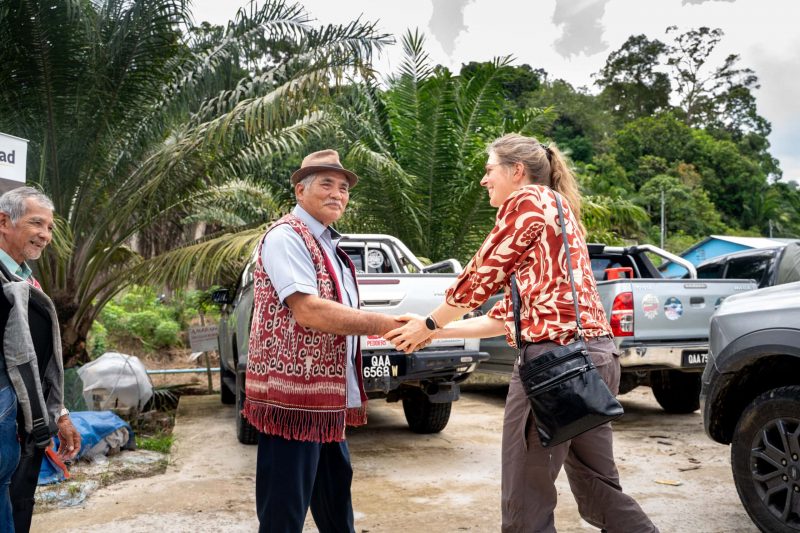
If companies are nudged to use such approaches, it would mean they would be stimulated to take more proactive approaches, rather than excluding perceived risk-prone suppliers (smallholder farmers) for EUDR intended flows. It would stimulate them to ask: ‘How can we address risks associated with these regions?’ Rather than ‘How can we get these regions or smallholders out of our value chain?’
By encouraging companies to develop long-term, holistic risk mitigation strategies—not just those focused on non-deforestation and legality—but also on forest preservation (or even reforestation) and inclusion of the rights of smallholders, Indigenous Peoples, and local communities, the EUDR requirements could foster proactive, collective organization, programmes and partnerships needed to mitigate a wide range of risks, ultimately strengthening EUDR compliance in the long run as well.
Requiring such approaches under the EUDR would encourage competent authorities to ask critical questions when assessing due diligence systems and risk mitigation strategies like: How does your risk mitigation programme effectively mitigate the risk of your imported product being linked to deforestation?
Actually OECD Due Diligence Guidelines already require companies to implement such approaches. The further requirement and enforcement under the EUDR would strengthen these existing requirements and create a stronger pull. In the future the same questions will be required to deliver upon the CSDDD and the Forced labour regulation.
In summary, if both companies and competent authorities prioritise Risk-based due diligence (Arts. 8–11) to demonstrate a negligible risk tied to the imported products, instead of exclusion, I hope and expect there is a bigger chance of EUDR stimulating companies to implement proactive programmes leading to forest conservation and farmer resilience. This way, EUDR can actually drive massive positive impact.


