The World Cocoa Foundation (WCF), in partnership with the Ghana Cocoa Board (COCOBOD), is pleased to announce that Ghana will host the 2027 World Cocoa Foundation Partnership Meeting in Accra from 17–18 March 2027. The world’s leading global conference in
Three days at the heart of African coffee. Six reasons to attend: Founded in July 2000, the African Fine Coffees Association is a member-based, non-profit body representing producers, traders, governments and support organisations across the continent. For over twenty years
From Origin to Opportunity: Connecting Global Standards, Trade and Knowledge The ASEAN International Coffee Summit 2026 is a premier three-day gathering that brings together the global coffee community in Singapore from 4 to 6 November 2026. Designed as a platform
Implementing new legislation takes more than technical knowledge. It requires practical guidance, trusted expertise and the confidence to make informed decisions. Our training turns complex legislation into clear, actionable understanding. Join at the Watershed in Bristol for a 2-day workshop. Learn
This technical workshop will bring together experts from producing-country agencies, EU institutions, Competent Authorities, research organisations, service providers, operators and supply chain stakeholders to advance dialogue and collaboration on improving the quality, accessibility and use of geospatial data for EUDR
Legality is a core pillar of the due diligence required under the European Union Deforestation Regulation (EUDR). Operators must verify that commodities were produced in compliance with the relevant legislation applicable to the area of production. The Commission committed to
We are happy to announce a follow‑on DIASCA Income Working Group meeting facilitated by Jessica Mullan from the Committee on Sustainability Assessment (COSA). We cordially invite you to join us for the next session. In our last session, we aligned
Malaysian Sustainable Natural Rubber (MSNR) Global Alliance serves as a collaborative form for Malaysia’s rubber industry and global partners in addressing current challenges and unlocking new opportunities to strengthen market access, drive sustainability and innovation. The objectives are:
There is no more waiting room. EUDR applies from 30 December 2026 for large and medium operators, and from 30 June 2027 for micro and small enterprises. The Commission’s simplification package adjusted product scope, updated the Information System and expanded
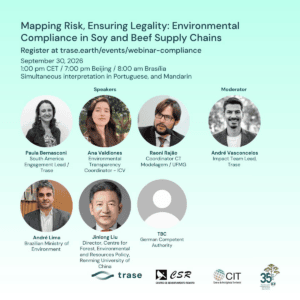
On September 30th, join for the webinar Mapping Risk, Ensuring Legality: Environmental Compliance in Soy and Beef Supply Chains. We will present the latest assessment of compliance levels across soy and beef supply chains in the Brazilian Amazon and Cerrado.
Smallholder farmers, private sector, and civil society organizations along the value chains
Key activities:
Empowering Smallholder Farmers and Farmer Organizations by facilitating traceability and legality, building capacity on Good Agriculture Practices (GAP), and strengthening farmer organizations, ensuring inclusive support for both men and women farmers.
Promoting sustainable practices and collaboration by supporting village HCV/HCS conservation efforts, testing and strengthening the National Dashboard for traceability and legality, and fostering national and regional exchanges.