Events

Research Symposium
10. - 11.09.2026
Collective Insights from Recent Research on
Deforestation-Free Value Chains and the EUDR
  • Reset filter

The European Union Deforestation Regulation (EUDR) legislation is a complex and evolving piece of legislation that impacts businesses trading in Europe across key seven key commodities – beef, cocoa, coffee, palm oil, soy, rubber and wood. This free webinar will

The primary barrier to scaling digital agriculture isn’t a lack of technology, it’s an underdeveloped delivery system. To unpack what this means in practice (for investors, businesses, and governments), we are launching a 3-part series – Closing the Digital Adoption

As EUDR regulations are set to be implemented next year, member jurisdictions and partners, including Proforest will discuss the challenges and solutions for meeting new deforestation-free supply chain requirements.

Boosting Technological Innovation and Trade The forum discusses how technological innovation can make global trade more sustainable and inclusive, with a focus on supporting SMEs and developing countries in navigating supply chain challenges. Register here until April 30, 2026.

Over the last few years regulatory frameworks, such as the EUDR, have accelerated advances in traceability, geolocation, and data management across supply chains. In preparing for compliance for regulation, companies have developed and utilized datasets, digital systems, and third-party service

The EUDR regulatory landscape is shifting again. The European Commission’s Simplification Review is due by 30 April 2026, with a mandate to assess the regulation’s administrative burden and impact, particularly for smaller operators, and potentially accompany the review with a legislative

Join the first DIASCA Dialogue on 27 April 2026, a new event series created to foster exchange and co-creation around Digital Public Infrastructure for sustainable supply chains. This inaugural session will focus on forest monitoring and feature the Thünen Institute

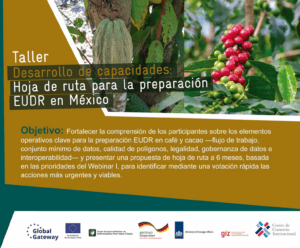
This webinar focuses on preparing the Mexican coffee and cocoa sectors for compliance with the EU Deforestation Regulation (EUDR). It brings together practical experiences, existing traceability systems, and coordination challenges across producing and importing countries. The session highlights key disparities

Cocoa
Coffee

As part of the TEI Outreach activities, the Eurotrip aims to facilitate the exchange between EUDR implementing partners from Asian and Pacific countries and key European stakeholders involved in the operationalisation of the EU-Deforestation Regulation. The visit will focus on

Palm Oil
Rubber
Wood

This webinar series brings together producers from Latin America and operators in Europe to exchange experiences on due diligence and compliance with emerging global regulations affecting agricultural value chains. Organized under the UN-REDD Programme, the series aims to foster dialogue

Region:

Luwero, Nakaseke, Kassanda, Mubende, Bukomansimbi, Kyotera, Omoro, and Nwoya

Target group:

Smallholder farmers, traders, state and non state actors, and processors

Key activities:
  • Capacity building of smallholder coffee farmers in production practices and sustainable land use management.
  • Establishing traceability system and facilitating access to sustainable financing 
  • Facilitate inclusive business partnerships between producer organizations and supply chain actors​ 
  • Promote multi-stakeholder cooperation​ 
Commodities:
Region:

Huánuco, Ucayali, Pasco and Junín

Target group:

Public and private stakeholders, especially exporting companies, cooperatives and smallholder producers

Key activities:
  • Strengthen the supply chains to meet EUDR requirements 
  • Facilitate access to sustainable finance and knowledge exchange
  • Training of smallholders to sustainable manage their production systems 
Commodities:
Region:

Ngozi and Kayanza 

Target group:

Smallholders

Key activities:
  • Training on the use of traceability tools and support on collection of geolocation data for EUDR compliance 
  • Support the development of a national coffee sector dashboard for traceability and transparency
  • Capacity building of smallholder coffee farmers in production practices and sustainable land use management.​ 
Commodities:
Region:

Centre, South West, Littoral, South, East and West regions

Target group:

Smallholder farmers, women, youth, and indigenous peoples

Key activities:
  • Develop inclusive business partnerships with the private sector 
  • Facilitate access to finance for sustainable business models 
  • Support and train farmers in open-source traceability systems 
  • Promote multistakeholder dialogues to improve legal and regulatory provisions 
Commodities:
Region:

(Lower) Kafue Catchment Ecosystem

Target group:

Farmers and community forest management groups

Key activities:
  • Support community forest management groups in the
    sustainable management of natural resources and livelihood creation
  • Support farmers to produce soy in line with the EUDR and increase productivity, and implement transparency and traceability pilots
Commodities:
Region:

Lampung, West Kalimantan, and Central Sulawesi

Target group:

Smallholder farmers, private sector, and civil society organizations along the value chains

Key activities:
  • Empowering Smallholder Farmers and Farmer Organizations by facilitating traceability and legality, building capacity on Good Agriculture Practices (GAP), and strengthening farmer organizations, ensuring inclusive support for both men and women farmers.
  • Promoting sustainable practices and collaboration by supporting village HCV/HCS conservation efforts, testing and strengthening the National Dashboard for traceability and legality, and fostering national and regional exchanges.
Commodities:
Region:

Son La, Gia Lai ​​

Target group:

Smallholder farmers and marginalized groups

Key activities:
  • Support coffee value chain actors
  • Foster deforestation-free, sustainable, and legal supply chains
Commodities:
Region:

Yangambi Biosphere Reserve, Salonga National Park North, Salonga National Park South, Virunga National Park, Kahuzi-Biéga National Park​

Target group:

Public and private sector

Key activities:
  • Promote sustainable agricultural practices
  • Minimize forest degradation
  • Prevent deforestation
Commodities:
Region:

Provinces of Orellana and Sucumbíos

Target group:

Smallholder farmers, women, indigenous people and youth

Key activities:
  • Promoting Multi Stakeholder Dialogues
  • Improving traceabilty systems
Commodities:
Region:

Xingu territory, State of Pará

Target group:

Family farmers

Key activities:
  • Improve market access, value creation, and access to sustainable finance
  • Integrate farmers into traceability systems
Commodities:
Global activities