Events

Research Symposium
10. - 11.09.2026
Collective Insights from Recent Research on
Deforestation-Free Value Chains and the EUDR
  • Reset filter

The symposium aims to present and synthesize the latest scientific research on deforestation-free value chains and EUDR aspects.  By showcasing results from ongoing studies and emerging practical operational work related to the EUDR and the agriculture-forest-trade-nexus, it connects academia with political stakeholders and implementing partners to foster exchange, alignment,

Palm Oil & Beyond: Technology, Biodiesel and Biomass Shaping a Greener Asia. Marking its 15th consecutive year, the Asia Palm Oil Conference (APOC) 2026 – hosted by the Thai Palm Oil & Oil Palm Association – stands as the leading

Palm Oil

What are necessary components for creating effective, harmonised, and coherent policy initiatives that promote a living income? Closing the living income gap at scale increasingly depends on coordinated national and regional policy strategies. Yet practical, experience-based insights on how these

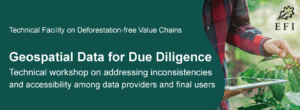
The Free and Open-source Tools Explainer: an interactive catalogue designed to help supply chain actors navigate the different technological tools developed primarily within the Team Europe Initiative for Deforestation-Free Value Chains (TEI). These tools support users in areas such as deforestation

El Salón del Cacao y Chocolate Internacional 2026 es el evento más importante de promoción, innovación y desarrollo del sector cacaotero y chocolatero del Perú y Latinoamérica. Se realizará del 16 al 19 de julio en el Centro de Convenciones

Cocoa

On 16 July 2026, Ms Hannelore Beerlandt, Head of Operations at the International Coffee Organization (ICO), will participate in this DIASCA Dialogue to present the work being undertaken by the ICO through its Coffee Public-Private Task Force (CPPTF) to support

Alliance for Integrity, together with FIT for FAIR — projects implemented by GIZ — and in partnership with our strategic ally amfori, we invite you to participate in this webinar on human rights and environmental due diligence in agricultural supply chains. Due

The New York and Amsterdam Declarations, together with France’s National Strategy on Imported Deforestation (SNDI), adopted before the European Deforestation Regulation (EUDR), reflect strong public and private interest in making agricultural and forestry value chains more responsible, especially in relation

Regenerative agriculture is one of the most promising pathways to raise and stabilize smallholder farmer incomes. This webinar presents two new papers showing how regenerative agriculture can meaningfully narrow the gap to a living income, while recognizing that it cannot

We invite you to our upcoming session “1+1=3: Approaches and benefits of public-private collaboration” where we will explore the benefits of public-private collaboration in the transition to deforestation-free and sustainable value chains in the context of the EU Deforestation Regulation (EUDR). Deforestation-free

Region:

Luwero, Nakaseke, Kassanda, Mubende, Bukomansimbi, Kyotera, Omoro, and Nwoya

Target group:

Smallholder farmers, traders, state and non state actors, and processors

Key activities:
  • Capacity building of smallholder coffee farmers in production practices and sustainable land use management.
  • Establishing traceability system and facilitating access to sustainable financing 
  • Facilitate inclusive business partnerships between producer organizations and supply chain actors​ 
  • Promote multi-stakeholder cooperation​ 
Commodities:
Region:

Huánuco, Ucayali, Pasco and Junín

Target group:

Public and private stakeholders, especially exporting companies, cooperatives and smallholder producers

Key activities:
  • Strengthen the supply chains to meet EUDR requirements 
  • Facilitate access to sustainable finance and knowledge exchange
  • Training of smallholders to sustainable manage their production systems 
Commodities:
Region:

Ngozi and Kayanza 

Target group:

Smallholders

Key activities:
  • Training on the use of traceability tools and support on collection of geolocation data for EUDR compliance 
  • Support the development of a national coffee sector dashboard for traceability and transparency
  • Capacity building of smallholder coffee farmers in production practices and sustainable land use management.​ 
Commodities:
Region:

Centre, South West, Littoral, South, East and West regions

Target group:

Smallholder farmers, women, youth, and indigenous peoples

Key activities:
  • Develop inclusive business partnerships with the private sector 
  • Facilitate access to finance for sustainable business models 
  • Support and train farmers in open-source traceability systems 
  • Promote multistakeholder dialogues to improve legal and regulatory provisions 
Commodities:
Region:

(Lower) Kafue Catchment Ecosystem

Target group:

Farmers and community forest management groups

Key activities:
  • Support community forest management groups in the
    sustainable management of natural resources and livelihood creation
  • Support farmers to produce soy in line with the EUDR and increase productivity, and implement transparency and traceability pilots
Commodities:
Region:

Lampung, West Kalimantan, and Central Sulawesi

Target group:

Smallholder farmers, private sector, and civil society organizations along the value chains

Key activities:
  • Empowering Smallholder Farmers and Farmer Organizations by facilitating traceability and legality, building capacity on Good Agriculture Practices (GAP), and strengthening farmer organizations, ensuring inclusive support for both men and women farmers.
  • Promoting sustainable practices and collaboration by supporting village HCV/HCS conservation efforts, testing and strengthening the National Dashboard for traceability and legality, and fostering national and regional exchanges.
Commodities:
Region:

Son La, Gia Lai ​​

Target group:

Smallholder farmers and marginalized groups

Key activities:
  • Support coffee value chain actors
  • Foster deforestation-free, sustainable, and legal supply chains
Commodities:
Region:

Yangambi Biosphere Reserve, Salonga National Park North, Salonga National Park South, Virunga National Park, Kahuzi-Biéga National Park​

Target group:

Public and private sector

Key activities:
  • Promote sustainable agricultural practices
  • Minimize forest degradation
  • Prevent deforestation
Commodities:
Region:

Provinces of Orellana and Sucumbíos

Target group:

Smallholder farmers, women, indigenous people and youth

Key activities:
  • Promoting Multi Stakeholder Dialogues
  • Improving traceabilty systems
Commodities:
Region:

Xingu territory, State of Pará

Target group:

Family farmers

Key activities:
  • Improve market access, value creation, and access to sustainable finance
  • Integrate farmers into traceability systems
Commodities:
Global activities