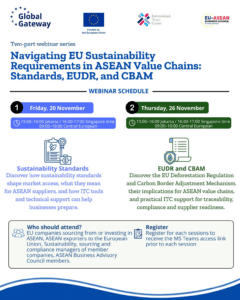
Sustainability requirements are increasingly shaping market access between the European Union and ASEAN. Voluntary sustainability standards, the EU Deforestation Regulation (EUDR) and the Carbon Border Adjustment Mechanism (CBAM) affect EU companies sourcing from and investing in the region, as well
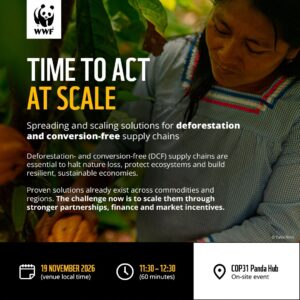
Deforestation- and conversion-free (DCF) supply chains areessential to halt nature loss, protect ecosystems and buildresilient, sustainable economies. Proven solutions already exist across commodities andregions. The challenge now is to scale them throughstronger partnerships, finance and market incentives. In this session
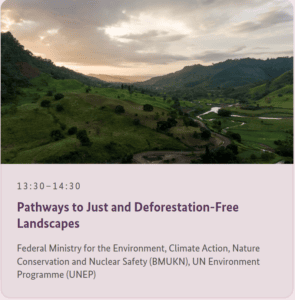
Halting and reversing deforestation and forest degradation by 2030, as enshrined in the first Global Stocktake of the Paris Agreement, requires addressing the underlying economic and structural drivers. These include unsustainable commodity production, land use change, illegal logging and other
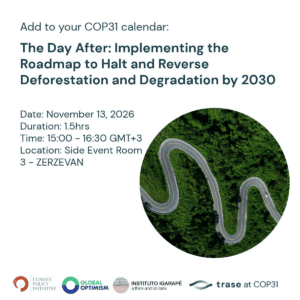
Forests are essential for climate, biodiversity, livelihoods, and economies. This event explores opportunities and pathways to implement the COP30 Presidency’s Forest Roadmap through global, regional, and national action, including finance, international cooperation, and regulatory bottlenecks. In collaboration with Climate Policy
This session will bring together experts including policymakers, researchers, and civil society organisations from producer and consumer countries. Speakers will share experience on forest-risk commodity supply chains, highlighting governance and research gaps. Drawing on lessons from the development and implementation
The EU Deforestation Regulation (EUDR) requires companies to show not only that their products are deforestation-free, but also that they were produced in line with the laws of the country of origin. For many companies, that second requirement is the
The Information System is a specialised online tool of the TRACES platform. It allows operators and their authorised representatives to create due diligence statements and simplified declarations, and submit them to the relevant authorities to show that their products do
As coffee-producing countries and supply-chain actors advance their preparations for the EU Deforestation Regulation (EUDR), the third session will bring together regional perspectives and practical experiences from Latin America, cooperatives, and exporters to explore implementation challenges and lessons for Africa’s
The Information System is a specialised online tool of the TRACES platform. It allows operators and their authorised representatives to create due diligence statements and simplified declarations, and submit them to the relevant authorities to show that their products do
The European Forest Institute (EFI) and Trase are facilitating a collaborative process to develop an independent framework for monitoring the impacts of the EU Deforestation Regulation (EUDR). Over the past year, the EUDR Impact Monitoring Community of Practice has helped
Smallholder farmers, private sector, and civil society organizations along the value chains
Key activities:
Empowering Smallholder Farmers and Farmer Organizations by facilitating traceability and legality, building capacity on Good Agriculture Practices (GAP), and strengthening farmer organizations, ensuring inclusive support for both men and women farmers.
Promoting sustainable practices and collaboration by supporting village HCV/HCS conservation efforts, testing and strengthening the National Dashboard for traceability and legality, and fostering national and regional exchanges.