This study provides an empirical assessment of Ethiopian smallholder coffee farmers’ preparedness for the European Union Deforestation Regulation (EUDR), examining awareness, compliance capacity, and potential impacts, with particular attention to…
In response to public pressure, companies have increasingly adopted voluntary sustainable sourcing commitments. Yet, it often remains unclear whether such commitments lead only to the narrow goal of supplier compliance,…
The Commission adopted two measures on 13 July to support the implementation of the EU Deforestation Regulation (EUDR), which will begin to apply by the end of December. A Delegated…
Independent smallholders produce a significant share of the world’s palm oil but remain underrepresented in the traceable, certified, and compliant supply chains increasingly shaping market access. The Global Palm Oil…
The market conditions that helped drive sustainable palm oil over the past two decades are changing. The Global Palm Oil Outlook 2025 finds that future demand growth is increasingly concentrated…
The palm oil sector has built a substantial framework for sustainability over the past two decades through certification, corporate commitments, national standards, and, more recently, mandatory due diligence regulations. These…
The study examines through a desk research and interviews Thailand’s alignment with the EUDR by developing a clear understanding of the environmental and social risks facing its palm oil and…
The study examines through a multi-method approach the alignment of current traceability systems and sustainability standards used by supply chain actors in Thailand with the main EUDR requirements, focusing on…
Increasing due diligence requirements are shaping how producing countries maintain access to European markets. Within the FIT for FAIR project, cross-country learning sessions are organized to exchange experiences on operationalizing…
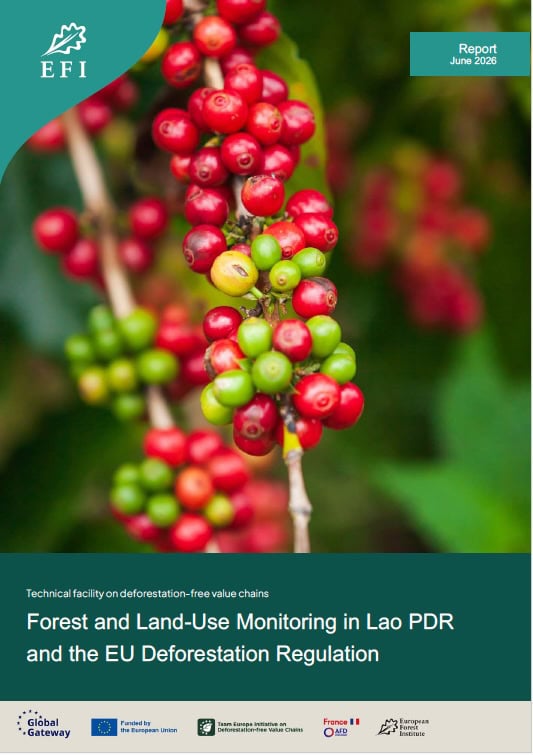
This report assesses forest and land-use monitoring systems in the Lao People’s Democratic Republic in relation to the requirements of the European Union Deforestation Regulation (EUDR). It aims to support…
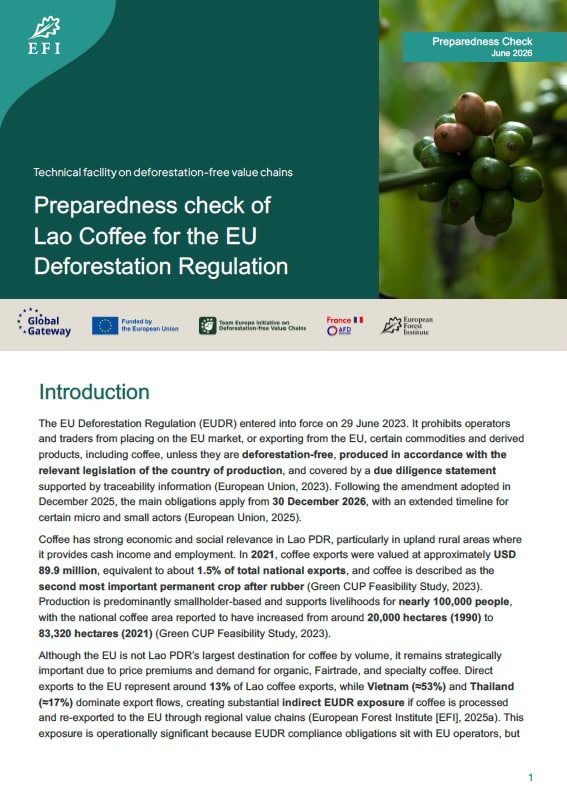
The EU Deforestation Regulation (EUDR), in force since June 2023, prohibits placing coffee and other commodities on the EU market unless they are deforestation-free, legally produced, and supported by due…
Women play a pivotal role in production and post-harvest processing, which often significantly determines the size and quality of the final commodities produced (FAO, 2016). Integrating GEDSI (Gender Equality, Disability,…
This study develops an EUDR-aligned 2020 forest boundary map for four pilot communes in Quang Trị province and compares it with GFC2020 v2, a global map of forest cover 2020….
The study synthesizes existing research and provided additional field evidence from the provinces of Lâm Đồng and Đắk Lắk (coffee), Đồng Nai (rubber) and Gia Lai (timber) to assess EUDR…
The Eurotrip is an outreach activity of the Team Europe Initiative (TEI) on Deforestation-Free Value Chains, which aims to support partner countries in their commitment to sustainable, deforestation-free and legal…
The purpose of this guide is to support companies, governments, tool developers, certification systems, nongovernmental organizations (NGOs) and other stakeholders in understanding and implementing effective traceability, with the larger goal…
Between 2005 and 2023, Italian consumption of palm oil, beef products, soy, wood, coffee, cocoa, and natural rubber has put approximately 594,000 hectares of forest at risk, equivalent to 100…
The 2026 Coffee Barometer delivers a 20-year retrospective exposing systemic industry flaws that keep producers vulnerable despite historic price highs. Marking a major shift from voluntary pledges to mandatory regulations…
This publication examines Malaysia’s efforts to strengthen smallholder readiness for compliance with the European Union Deforestation Regulation (EUDR), which requires deforestation-free supply chains for key commodities, including palm oil. Focusing…
This Knowledge Publication, developed for the fifth Regional Technical Dialogue (RTD#5) under the Sustainable Agriculture for Forest Ecosystems (SAFE) project, examines the urgent need for inclusive and scalable financing mechanisms…
Agricultores y grupos de gestión forestal comunitaria
Actividades clave:
Apoyar a los grupos de gestión forestal comunitaria en la gestión sostenible de los recursos naturales y la creación de medios de vida.
Apoyar a los agricultores para que produzcan soja de acuerdo con el EUDR y aumenten la productividad, e implementar pilotos de transparencia y trazabilidad
Pequeños agricultores, sector privado y organizaciones de la sociedad civil a lo largo de las cadenas de valor
Actividades clave:
Empoderar a los pequeños agricultores y las organizaciones de agricultores facilitando la trazabilidad y la legalidad, desarrollando capacidades en buenas prácticas agrícolas (BPA) y fortaleciendo las organizaciones de agricultores, asegurando un apoyo inclusivo tanto para los hombres como para las mujeres agricultoras.
Promover prácticas sostenibles y colaboración apoyando los esfuerzos de conservación de HCV/HCS de las aldeas, probando y fortaleciendo el Tablero Nacional para la trazabilidad y legalidad, y fomentando intercambios nacionales y regionales.